After a Week of Mixed Results, AI Delivers Something My Kid Actually Loves
Last night's experiment started with homework frustration and ended with genuine delight, the kind where my seven-year-old actually asked to do more word practice. If you're a parent who's witnessed t...
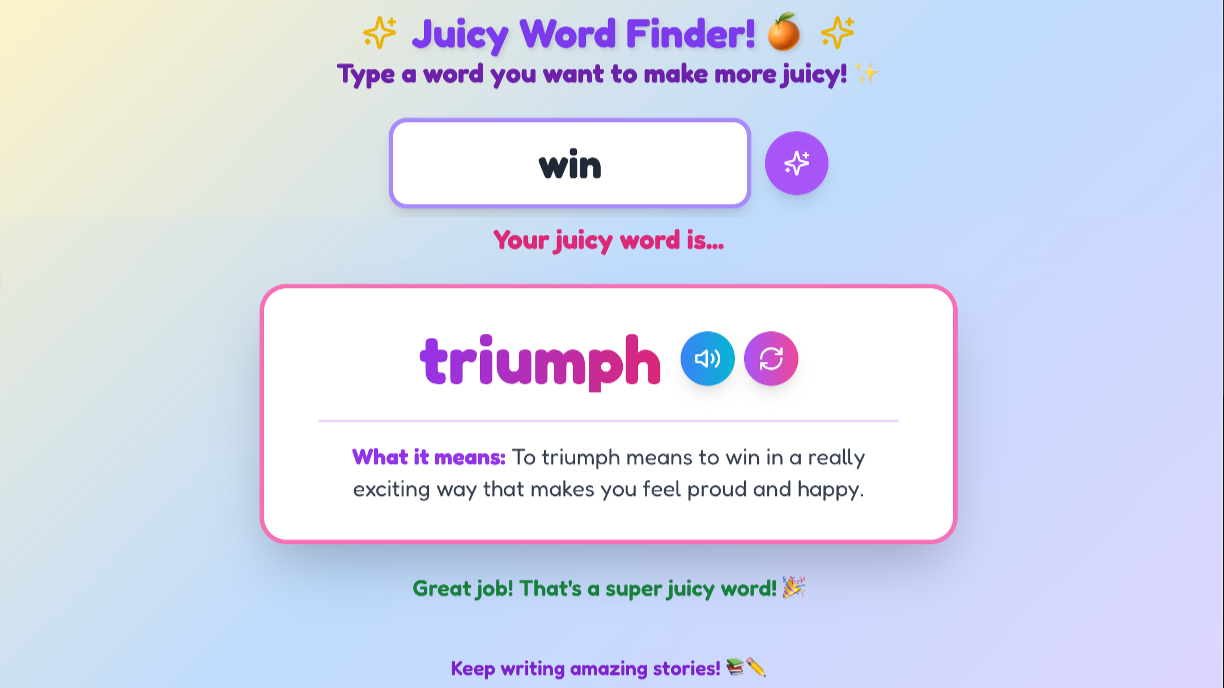
Last night's experiment started with homework frustration and ended with genuine delight, the kind where my seven-year-old actually asked to do more word practice. If you're a parent who's witnessed the homework meltdown phenomenon, you know this borders on miraculous.
Here's what happened: My daughter was working on finding "juicy words" for her writing assignment. You know the drill: replace boring words with exciting ones. "Big" becomes "enormous." "Said" becomes "exclaimed." Standard second-grade stuff that somehow turns into a 45-minute battle of wills.
Instead of our usual routine (me suggesting words while she insists they're "not juicy enough"), I decided to try something different. I opened Claude and asked it to create an interactive Juicy Word Finder tool using Artifacts.
Within minutes, we had a custom tool where she could type in any boring word and get a "juicy" alternative. But here's where it got interesting, and where AI showed its actual value rather than its marketing promises.
When my daughter wanted to know what "plummeted" meant (one of the juicy alternatives for "fell"), I asked Claude for the definition. Without any prompting from me about age-appropriate language, Claude recognized from our conversation that this was for a second grader and automatically provided definitions in simple, clear language she could understand.
Instead of "plummeted: to fall perpendicularly or abruptly," we got "plummeted: fell down really fast, like dropping straight down from the sky."
That is intelligent context awareness. Not the kind vendors talk about in their demos, but the kind that actually matters in real-world use.
What worked:
The tool was genuinely interactive: my daughter controlled it herself, typing in words and seeing instant results Definitions were automatically calibrated to a seven-year-old's comprehension level The visual feedback (colorful interface, immediate responses) kept her engaged She felt ownership over the process since she was "driving" the tool
What this reveals:
This experiment highlighted something I've been noticing across multiple tests: AI tools excel when they can leverage context naturally rather than through explicit instructions. I never told Claude to "write definitions for a second grader." It inferred this from our conversation flow and adjusted accordingly.
Compare this to my recent Microsoft Copilot PDF experiment, where explicit instructions to extract specific data failed spectacularly. The difference? Claude was working within its strength zone (understanding conversational context and generating appropriate responses) while Copilot was trying to perform precise data extraction, a task that exposed its limitations.
The bigger picture:
Too often, we try to force AI tools to replace existing workflows entirely. Last night's success came from using AI as a creative supplement to homework time, not a replacement for learning. My daughter still had to think about which words needed jazzing up. She still had to choose which alternatives fit her sentences. The tool just made the discovery process more engaging and accessible.
Today's question:
Could this same approach work for other homework challenges? Math word problems translated into kid-speak? Science concepts explained through their favorite characters? The potential is intriguing, but as always, the real test will be in the implementation.
For now, though, I'm calling this one a win. Not because the AI was revolutionary, but because it did exactly what good technology should do: it made a frustrating task easier and more enjoyable for its user. Even if that user is eight and thinks K-Pop Demon Hunters is cinematic gold.
Tools Used
Tool tested: Claude Artifacts - Cost: Claude Pro subscription ($20/month) - Time to create: About 10 minutes - Success level: Exceeded expectations