The Case of the Color-Changing (and Sometimes Disappearing) Shirt
The Challenge: A friend needed her headshot edited to match her brand colors - specifically, changing her blue dress to purple. Simple enough, right? Well, as with most things in AI, the journey was m...
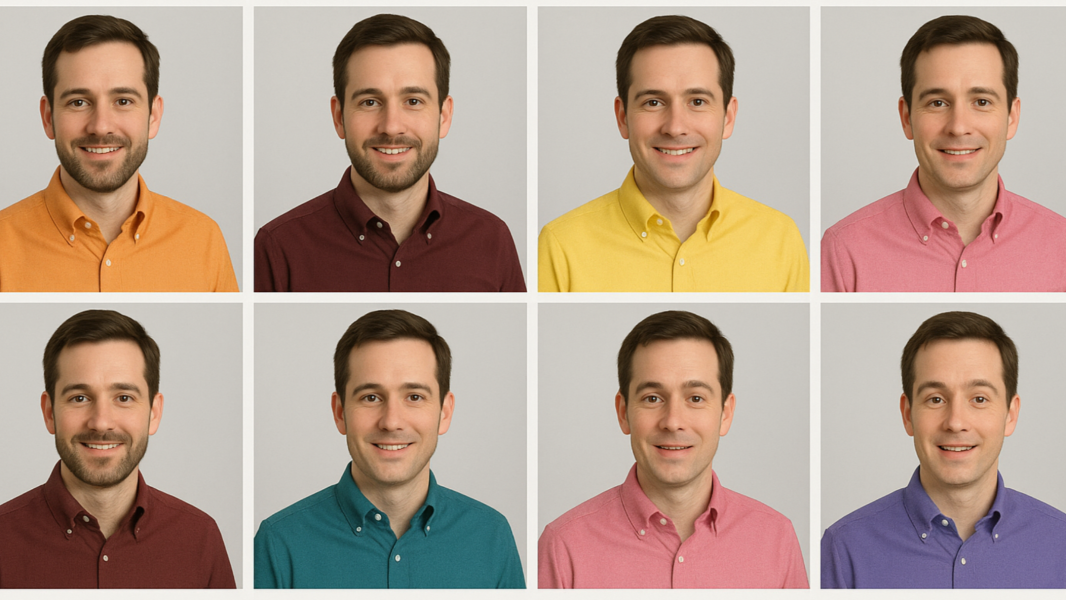
The Challenge: A friend needed her headshot edited to match her brand colors - specifically, changing her blue dress to purple. Simple enough, right? Well, as with most things in AI, the journey was more interesting than expected.
The Experiment Path
First Stop: FaceTune
My instinct was to reach for the specialized tool. FaceTune has solid photo editing capabilities and usually offers trial access to new features. Their natural language editing seemed perfect for this task.
Attempt #1: "Make her dress purple" Result: The AI decided my friend didn't need a shirt at all. Not quite the professional look we were going for.
Attempt #2: "Make the blue dress she is wearing purple" Result: A purple sequined tube top materialized. Festive? Yes. Professional headshot appropriate? Not so much.
Second Stop: FaceTune's Clothing Editor
Time to try a more structured approach. I dove into their clothing editor feature, searching for purple professional attire.
The closest match: A pink button-up shirt Result: The swap worked, except the AI rendered it completely unbuttoned. We're sensing a pattern here with FaceTune's interpretation of professional attire.
Final Stop: ChatGPT
At this point, why not try the general-purpose model?
The prompt: "Make her shirt purple instead of blue" Result: Perfect. Not only did it change the color accurately, but it preserved the original dress's style, maintained the dark and light color variations, and kept everything appropriately buttoned and professional.
The Takeaway
Sometimes we assume specialized tools will outperform general models at specific tasks. After all, that's what they're built for, right? But today's experiment revealed an important lesson: general-purpose AI models can sometimes outperform specialized tools, especially for straightforward transformations.
ChatGPT likely succeeded because:
It understood the context better (professional headshot = keep it professional) It focused on color transformation rather than clothing replacement It preserved the original garment's characteristics while only changing the specified attribute
The Meta-Lesson
When tackling an AI task, consider starting with the generalist before moving to the specialist. It might save you from explaining to your friend why their professional headshot now features an unbuttoned shirt or sequined tube top.
Tools Used
FaceTune
What: AI-powered photo and video editing app Features tested: Natural language editing, Clothing editor Access: Free trial available for most features Link: facetune.com
ChatGPT
What: OpenAI's general-purpose AI assistant Feature used: Image editing via DALL-E integration Access: Available with ChatGPT Plus subscription Link: chat.openai.com
Experiment Stats:
Tools tested: 2 (with 4 different approaches) Unwanted wardrobe malfunctions: 3 Time to perfect result: ~15 minutes Lesson learned: Priceless
Have you had similar experiences where a general AI tool surprised you by outperforming a specialized one? Share your stories!
Tools Used
Tools: FaceTune, ChatGPT - Where to find them: FaceTune (mobile app stores), chat.openai.com - What it costs: FaceTune (free trial, then subscription), ChatGPT (free tier available, Plus subscription $20/month)