The Day Peloton Forgot My Run (and GPT 5 Rebuilt It from Disconnected Data Sources)
When your fitness app fails, AI can still finish the story.
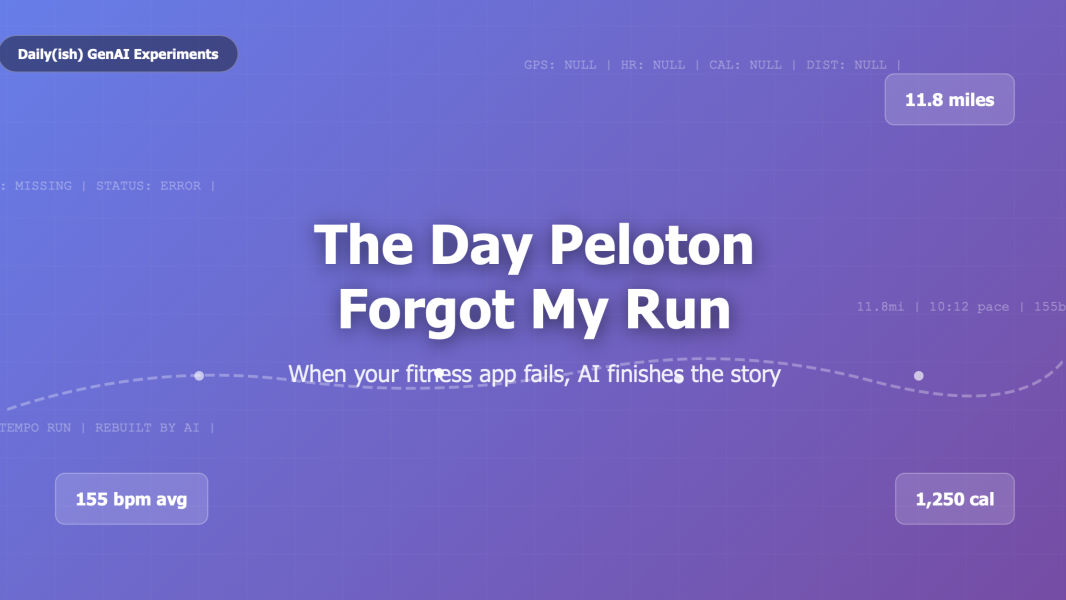
When your fitness app fails, AI can still finish the story.
My Peloton app glitched during a long run. GPS failed to connect, heart rate was tracking on my Apple Watch, but not properly in the Peloton app. Two hours of effort vanished into the digital void. Instead of giving up on logging the workout entirely, I turned to GPT 5 with a simple question: "Can you estimate my calorie burn from miles, pace, and heart rate?"
In seconds, it reconstructed everything. Based on 11.8 miles (which I was able to calculate in MapMyRun) at a 10:12 per mile pace and an average heart rate of 155 bpm hovering in upper Zone 3 to low Zone 4, it calculated approximately 1,250 calories burned. But the calculation itself wasn't the most valuable part of the interaction.
What followed was more illuminating. GPT 5 explained why Peloton doesn't allow manual workout entries and walked me through how to backfill the missing data through Apple Health or Strava instead. That was the real insight from this experiment.
Generative AI isn't just for writing or coding anymore. It functions as a thinking partner that can rebuild missing data, explain the logic behind system limitations, and translate raw numbers into actionable meaning. What started as a frustrating tech glitch turned into a small reminder that AI's usefulness often appears in the everyday gaps between our tools, filling in spaces we didn't even know needed filling.
What I Learned
Before calculating my specific workout, GPT 5 walked me through different methods for estimating calorie burn:
Basic method: Body weight and distance only (roughly 0.63 calories per pound per mile). Fast but least accurate since it ignores pace, terrain, and fitness level. Moderate accuracy: Adding pace and heart rate improves estimates to within 10-15% of lab measurements. Heart rate captures real effort including hills, heat, and fatigue. Highest accuracy: VO2 max and metabolic equations account for individual running economy. Requires fitness testing data most people don't have.
The real insight wasn't just getting a number to log, it was understanding why different tools make different tradeoffs between convenience and precision.
Written during a long-run recovery stretch fueled by curiosity and coffee.
Tools Used
Tool: ChatGPT (GPT 5) - Where to find it: chat.openai.com - What it costs: Could have used free ChatGPT, but Pro subscription made it faster ($20/month)